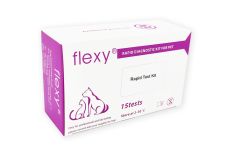
Feline Leukemia Virus Real-time PCR Test Kit
Feline Leukemia Virus Real-time PCR Test Kit is to detect leukemia virus in cat ascites, which is rapid, accurate and easy-to-operate. Sensitivity 100%, Specificity 100%.
Basic information
Feline leukemia virus (FeLV) is a retrovirus that infects cats. FeLV can be transmitted from infected cats when the transfer of saliva or nasal secretions is involved. If not defeated by the animal's immune system, the virus weakens the cat's immune system which can lead to diseases which can be lethal. This kit uses fluorescence probe PCR (RT-PCR) method to detect the conserved gene of FeLV, which is helpful for diagnosis, monitoring and epidemiological investigation of FeLV.
Key facts of the Feline Leukemia Virus Real-time PCR Test Kit
- Ready to use kits for the vet clinic
- No extraction required
- Result in 30min.
Feline Leukemia Virus Real-time PCR Test Kit Components
| Item # | Item | Qty |
|---|---|---|
| 1 | PCR reaction solution | 120ul |
| 2 | Negative Control | 50ul |
| 3 | Positive Control | 50ul |
| 4 | Exogenous Gene Control | 50ul |
| 5 | Sample buffer | 1ml |
| 6 | Enzyme mix | 10ul |
| 7 | Kit user manual | 1set |
What causes FeLV infection?
FeLV is categorized into four subgroups, A, B, C and T. An infected cat has a combination of FeLV-A and one or more of the other subgroups. Exposure to the feline leukemia virus doesn’t have to be a death sentence; about 70% of cats who encounter the virus are able to resist infection or eliminate the virus on their own.
Why and how might my cat become infected?
Feline leukemia is a disease that only affects cats -- it cannot be transmitted to people, dogs, or other animals. FeLV is passed from one cat to another through saliva, blood, and to some extent, urine and feces. The virus does not live long outside the cat’s body -- probably just a few hours. Grooming and fighting seem to be the commonest ways for infection to spread. Kittens can contract the disease in utero or through an infected mother’s milk. The disease is often spread by apparently healthy cats, so even if a cat appears healthy, it may be infected and able to transmit the virus.
What happens during infection and how to diagnose it?
After being exposed to FeLV, the incubation period is two to 14 days before symptoms appear. Commercial labs detect the presence of FeLV in two ways: by ELISA antigen testing or through reverse transcriptase PCR (RT-PCR), a procedure that detects a segment of genetic material that is specific to leukemia virus. Both tests are equally effective, though the RT-PCR test may be more common in some areas. Test results should be interpreted carefully. Please always follow the advice of the doctor.
Extended reading
Frequently asked questions
Unlike the other manufacturer of research reagents, our products are well validated according to ISO standards and are designed for diagnostic purpose. Some of them are also validated by International Institute, such as AOAC-RI, ILVO, WOAH reference laboratories. Using our products, you will have reliability, affordability, and credibility. Our technical support team will also provide after-sale service in case you have any technical questions.